-
What is the Playboy Project?
Hi I’m Robyn.
For those of you who don’t know me or have perhaps stumbled upon this project as a result of it being shared by friends (Hi friends) or out of morbid curiosity, I am a recent University graduate who got themselves into student debt in order to write 10,000 words on what can only be described as science fiction porn.
Which I guess lends itself quite nicely to my current project, exploring the literary history of what is widely regarded as the most iconic and famous pornographic media titan in the world. Playboy.
Here is where I lay out my massive disclaimer that I am 1. Not affiliated with Playboy in anyway and 2. Do not endorse the actions of Hugh Hefner. I am merely just a girl, seeking the answer to one of life’s greatest mysteries: Can you ACTUALLY read Playboy just for the articles?
Before I go into the scope of the project itself, what it will entail and what I hope to get out of it, I thought I’d give a brief run-down of my personal history with Playboy and what inspired me to read hundreds of stories from a defunct men’s lifestyle magazine.
I grew up in the early 2000’s, a time rife with reality tv, handbag dogs and what I am going to call the Playboy renaissance. Unbeknownst to a preteen Robyn, Hugh Hefner at the time was living it up in the Playboy mansion with his myriad of blonde girlfriends and enough smoking jackets to clothe an army of OAPS. My exposure to Playboy was not through The Girls Next Door (I will come to this later) nor the television ads they ran advertising various bunny branded ventures, but through the decoration of a friend’s bedroom.
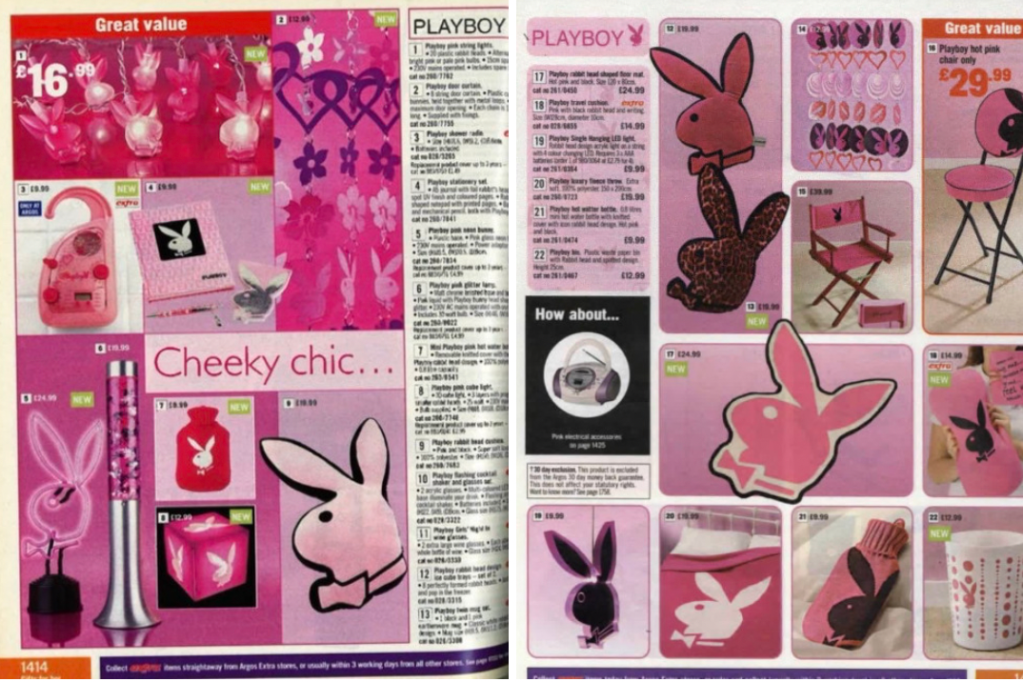
It seems nefarious looking back, but in the early oughts it was very common for girls barely even 13 to deck out their bedroom in pink and leopard print Playboy vomit straight from the back pages of the Argos catalogue. I remember walking into the bedroom of a classmate and seeing massive plush bunny heads all over her bunny print bedsheets and a sparkly bunny head lava lamp and bottles of bunny head branded perfume. At the time I thought it was a cute character, like Hello Kitty, but when I raised this to my parents, I remember getting the impression that it was something different, something not for me. Like 18 rated films or smoking, and I was instantly extremely confused as to why a girl my age was allowed to have her bedroom decorated this way when I wasn’t even allowed to watch Evil Dead yet.
Image from Tumblr user Zegalba I suppose I could go on here about the marketing of Playboy. And how its merchandise was targeting children through its colours and patterns, position in the cultural zeitgeist and its place in the Argos catalogue amongst the Groovy Chick bedspreads, but I am woefully unqualified and the 2000’s was long ago. I’m sure that battle has already been fought. However this close call with the collared rabbit left an impression on me and as such I became aware of the grown-ups around me joking about hiding copies of Playboy or buying issues as gag gifts along size boxes of man-sized Kleenex.
Playboy began to become something I was vaguely aware of as I entered adulthood. The porn magazine. The creepy old man publicly practising polygamy (Queue old ladies clutching their pearls). The phrase “I read them for the articles” when a man is challenged about having an issue under his bed, because God forbid anyone enjoy sex. But then Hef died, and I began seeing articles online about the women that had lived with him in the mansion over the years.
Holly Madison who had previously released a memoir detailing her experience as Hefener’s “main” girlfriend in the mid 2000’s, came up frequently in interviews on social media as she had starred in the reality television show The Girls Next Door which followed Hefer’s then three girlfriends and their lives at the mansion. So, like any nosy person, I brought her book and read it in the space of a few hours. I. couldn’t. put. it. down.
The atmosphere she describes is cult-like and I couldn’t believe the praise this man was getting despite all these women who had spoken out against him. I binged watched The Girls Next Door, comparing what I was seeing to Holly’s descriptions in her memoir. I began to devour documentaries about Playboy and listen to podcasts from former Bunnies and girlfriends alike trying to get an insight into how this man can be so adored and yet be such an asshole.
What I eventually learnt was that Hugh Hefner was a horrible abusive, manipulative man, who also was so integral to pop culture. He campaigned for LGBTQ rights and challenged segregation openly during the 60s and gave space for thinkers with alternative ideas a place to publish their thoughts and findings therefore making counterculture and liberal thinking increasingly accessible.
It was quite the tactic, come for the boobs, stay for the articles talking about decriminalising marijuana or the interviews with civil rights leaders or the science fiction icon’s thinly veiled socialist utopia. Playboy helped make Tv shows, films, philosophies, and counter cultures. For better or for worse, he helped shape massive socio-political movements through the articles in his porn magazine, and as such will perhaps live on in infamy for years to come.
While my intention is to prove with this project that Playboy as a publication had, and still has merit as a vessel for literature, this is not to say that its status as a pornographic magazine is not also extremely valid. Although Hef’s body standards when applied to me, a plus sized, tattooed and decidedly not blond woman, would gain me little more than perhaps a “D” rating on a polaroid somewhere in his mansion, that is not to say that Playboy didn’t contribute to the acceptance of sex in mainstream media and that pornography isn’t valid when it is safe sane and consensual.
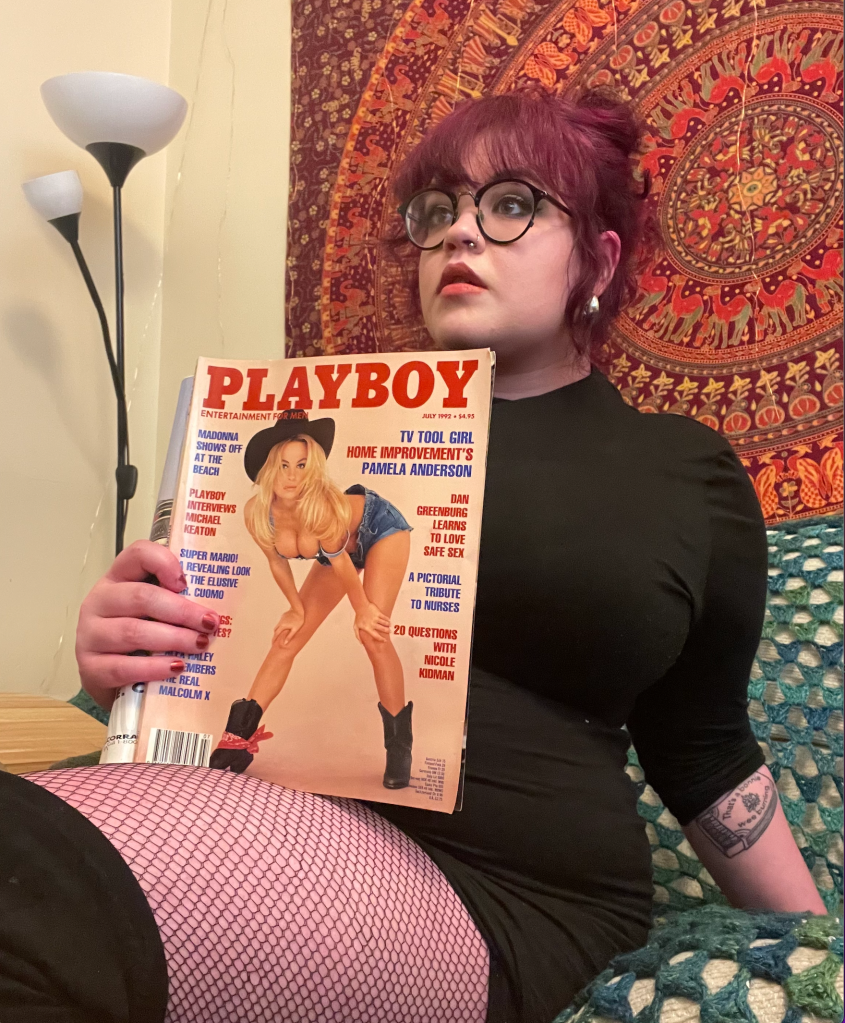
Myself holding July 1992’s Playboy I will not be discussing Hefner’s misdeeds and crimes, but I suggest if this is something you are interested in, checking out any of Holly Maddison’s projects, in particular her new podcast with Girls Next Door co-star Bridget Marquardet, Girls Next Level and watching the documentary The Secrets of Playboy.
Over the course of this project, I intend to read all the fiction published in the 690 issues put out since the magazine started in 1953. I will be highlighting and reviewing key pieces and discussing the socio-political context of the time they were published as well as what material they were printed alongside and the history of the magazine itself.
I will be writing up my thoughts and feelings in blog posts that consolidate my findings for each year and then an overview of trends in genre, author identity, and themes for each decade overall. I will be tracking the diversity of the authors published on various criteria and commenting on why I believe certain stories were chosen to be published at certain times, why certain authors were serialised and how they interact with the image of Playboy as a lifestyle.
So, get out your man size Kleenex (for me to gently weep into because I’ll have to read AT LEAST 10 medieval literature translations in the first decade) and follow me down this rabbit hole and into the 1950s where it all began.
XoXo Robyn
References :
- I Playboy : https://www.iplayboy.com
- The Girls Next Door. Created By, Kevin Burns & Hugh Hefner, Creators. E!, 2005-2009
- Madison, Holly. Down the Rabbit Hole: Curious Adventures and Cautionary Tales of a Former Playboy Bunny. Dey Street Books, 2015.
- Madison, Holly & Marquardt, Bridget. Hosts. Girls Next Level . 2022- https://open.spotify.com/show/4JstWABabZk3fLty7Rhmyt
- Secrets of Playboy. Produced by, Dolores Gavin, executive producer. A&E, 2022
-
Creating the Playboy Identity
We are governed , our minds are molded , our tastes formed , our ideas suggested , largely by men we have never heard of.
Bernays, Edward. Propaganda, p9. Ig Publishing. 2004In 1953 Hugh Hefner was an unknown college graduate who had just been let go from Esquire magazine and sought to create a publication for men with interests like him, hoping that his tastes would garner enough interest to make a profit.
Obviously we know now that this risk was wildly successful and that his kitchen table project would eventually become a phenomenon that would not only shape, but create culture for people the world over. It is through his genius marketing of The Playboy, a new identity for men to aspire to, that he managed to influence media, literature, consumer habits and beauty standards.
So who is The Playboy?
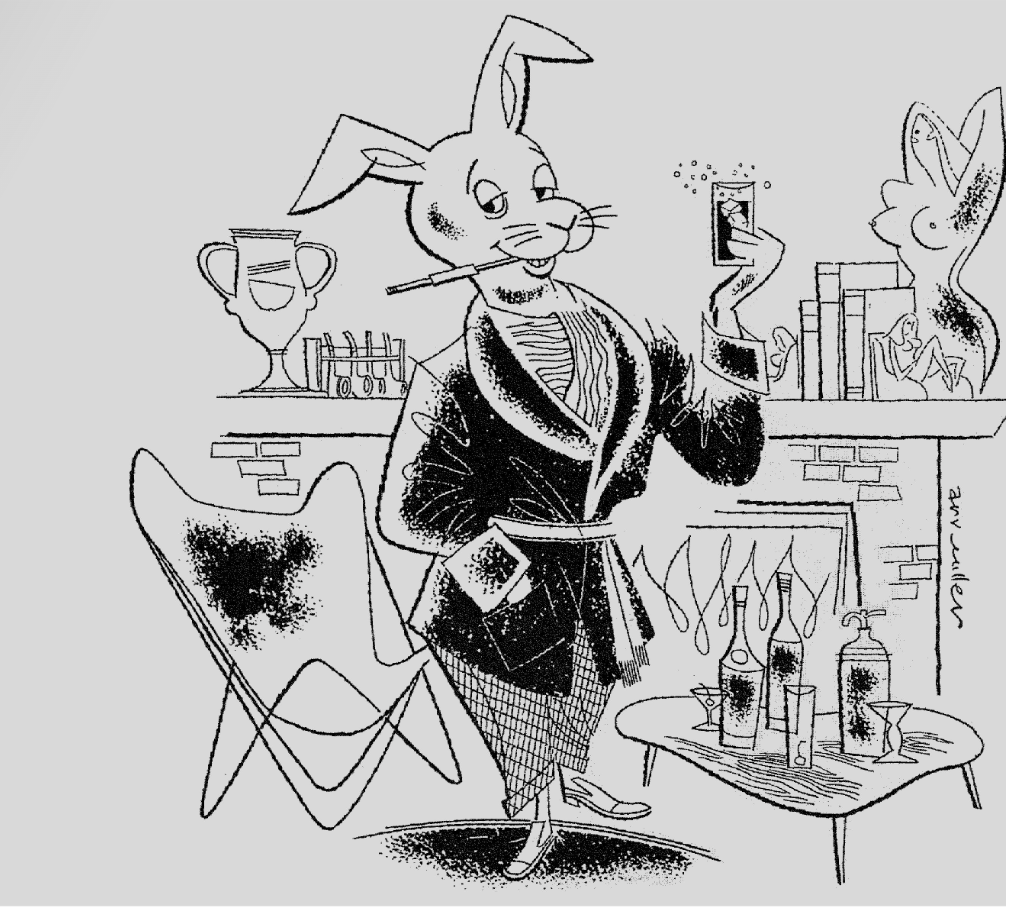
Cartoon from Playboy December 1953 by Arv Miller First and foremost the Playboy must be a man. If the gender bias wasn’t already painfully obvious by the use of the word “boy” in its branding, then Hugh Hefner’s insistence that ‘if you are somebody’s sister, wife or mother in law and you have picked us up by mistake, that you please pass us along to the man in your life and get back to your ladies home companion2 ‘ would definitely get the point across.
Like the famous not for girls marketing of the Yorkie brand in the early 00s, Playboy established itself as a just for men lifestyle magazine at a time where only two other publications existed in this category, priding itself on its styling of masculine taste.2
The articles of this first issue painfully reflect this with Bob Norman being given pages of space to express his frustration at paying alimony to his ex wife, comparing giving her money to buying oats for a dead horse3. The article ‘Miss Gold Digger 1953’, seems to encourage the lifestyle of a bachelor , painting wives as parasitic creatures that bleed men dry of money and with hold sex. In an attempt to ‘bolster the male ego by destroying woman’s’ 4. Playboy separates the women in its pages into two categories : sexual objects and women as they relate to the reader instead of people in their own right, at least to begin with.
The women in the pages are playful and sexually liberated, while any woman that exists outside its confines are boring, and uptight. Perhaps the decision to condemn marriage in this way was a reflection of Hefner’s growing distaste with his own relationship .
Hefner was not himself a Playboy when he launched the magazine, he was a poor college graduate married to a woman who had cheated on him, and the father to a 1 year old girl. Hefner’s interests in jazz, culture and women were indeed reflected in the first issue but the lifestyle he encourages of his readership was far from the lifestyle he was living. In this way Playboy not only represented a fantasy for its readers to strive towards5 but Hefner’s own alter ego, the man who could have it all – the man he would eventually become.
Published straight after Norman’s takedown of the institution of marriage, the article “Strip Quiz” depicts a naked woman playing a quiz game with two fully clothed men6.
Not only does this boost the male ego by implying that the women is losing a general knowledge game, it decides that within the covers of Playboy it is only women who are naked , not the men.
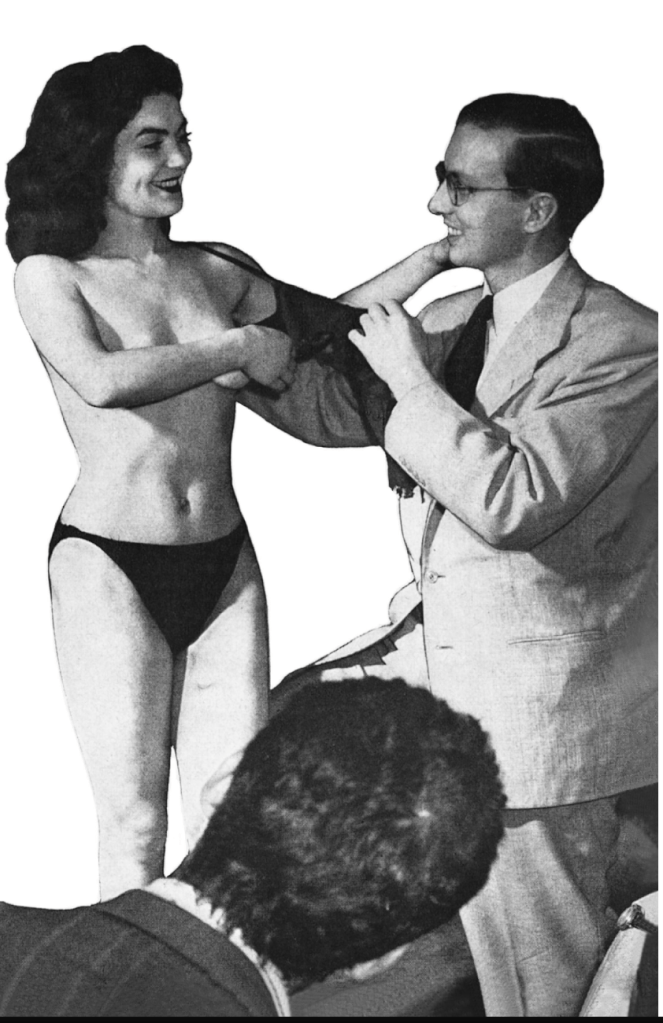
Image taken from Playboy December 1953 of two unnamed male models and a woman credited only as ‘Mademoiselle Genevieve’. While Hefner does advocate for gay rights and will go on to publish articles in the subject later on in the publication’s history, the decision to only publish women naked assumes the heterosexuality of the reader, enforcing that the Playboy as a concept is a straight male.
It is also true that due to media laws in the 50s publishing men and women naked together , or photographs of a full frontal male model, would have proven difficult. However, the inclusion of men in the pictures with women draws attention to their nakedness and establishes them as playthings not only for the men in the photographs, but for the reader. Of course these women would eventually become ‘Playmates’ a nod to Hefners branding but also a label that places hierarchical value on the male viewer.
Before I get ahead of myself and deconstruct the idea of the Playmate (which hadn’t yet been established as a term in the Playboy lexicon ) let’s return to Strip Quiz and the identity of the Playboy.
We know little about the woman in Strip Quiz aside from the fact that she is clearly not very good at general knowledge. However in the brief accompanying text that goes along side the pictorial , this simple game wherein the loser loses and item of clothing, is described as “European” a word which at the time had connotations of sophistication and forward thinking6.
America is often seen as the prudish distant relative of Europe, with the idea that nakedness and sexual liberation is rife across the pond. Americans often look to European countries as a places of great cultural capital so to describe this sexual game as European, legitimises it and makes the enjoyment of a naked body seem like an intellectual pursuit.
Playboy is often concerned with the cultural capital of its contents and by extension assumes or encourages the reader to be the sort of man who concerns himself with intellectual stimuli. Hefner paints the picture of the Playboy as a worldly figure by asking the reader if he is the sort if man who would “invite a female acquaintance for a quiet discussion on Picasso, Neitzsche , jazz, sex 1 ‘.
The Playboy isn’t a lecherous acne riddled ,hormonal teenage boy, the Playboy is an intelligent and sophisticated man who enjoys sex and is invited to enjoy it without shame. Hugh makes sex seem smart, and makes smartness seem sexy. He makes porn acceptable to a 1950s audience by framing it as an academic pursuit, it’s between the pages of freshly translated Boccaccio! How can it be wrong?
Finally a man had an excuse to engage with pornography, he was purchasing it for the articles. The naked women just happened to be there, like shadows of people running to the bathroom at the cinema, it only got in the WAY of what you are really there to see .
Of course Hefner happened to be passionate about the articles he published and was a fan of most of the things he selected, but this clever marketing technique managed to bypass the prudish values of 1950’s America and indeed allowed men to consume pornography freely across the globe in years to come.
The marketability of playboy as a publication was immense, and it is no wonder that it went on to be one of the largest magazine publications of all time. Hefner even built consumption into the created identity of his readership prepping them for future advertisements.
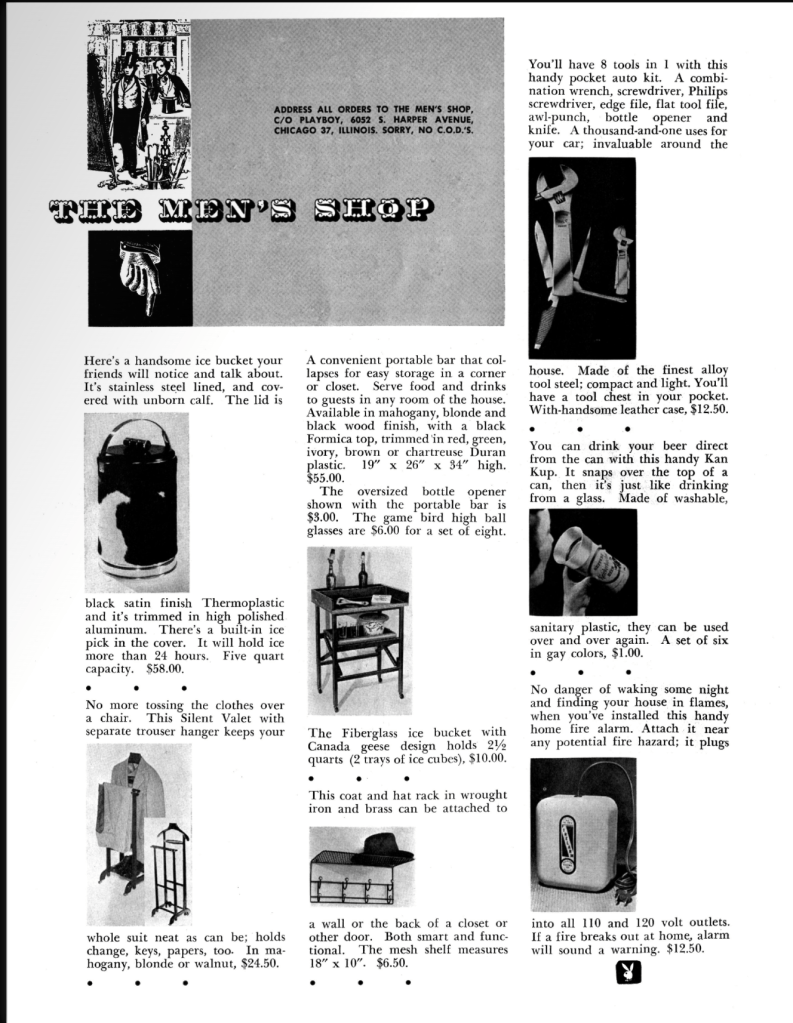
Consumer goods recommended by the magazine. The Playboy is an identity that can be brought. Aside from the gender bias, the marks of a Playboy are all linked to consumption. You can become intelligent by consuming culture and according to Hefner , you can access beautiful women by enticing them with the lifestyle that you market to them with the goods you have purchased.
In a pictorial called ‘An Open Letter from California’7 the model is portrayed as the girl next door who is entranced by the authors pool , and therefore is willing to engage in sexual play with him. Hefner creates a life for the reader to aspire to, if you want sex, success and intelligence you must become a Playboy, and to become the Playboy you must consume.
Bibliography
- Bernays, Edward. Propaganda. Ig Publishing. 2004
- Hefner, Hugh. ‘Volume 1 , Issue 1 : Introduction’. Playboy, December 1953, p3, Iplayboy.com Accessed November 11th 2022.
- Norman, Bob. ‘Miss Gold Digger 1953’. Playboy, December 1953 , p6-9, Iplayboy.com Accessed November 11th 2022.
- Rossi, Lee D. ‘The Whore Vs the Girl Next Door : Stereotypes of Woman in Playboy, Penthouse and Oui’. Journal of Popular Culture, 1975, Volume IX (1), p 90-94.
- Gunelius, Susan. ‘The Brand Dream’. Building Brand Value the Playboy Way. Palgrave Macmillan 2009.
- ‘Strip Quiz ‘. Playboy, December 1953, p10-11, Iplayboy.com Accessed November 11th 2022.
- ‘An Open Letter from California’ . Playboy, December 1953, p27-29, Iplayboy.com Accessed November 11th 2022.
-
Subscribe
Subscribed
Already have a WordPress.com account? Log in now.
 The Playboy Project