We are governed , our minds are molded , our tastes formed , our ideas suggested , largely by men we have never heard of.
Bernays, Edward. Propaganda, p9. Ig Publishing. 2004
In 1953 Hugh Hefner was an unknown college graduate who had just been let go from Esquire magazine and sought to create a publication for men with interests like him, hoping that his tastes would garner enough interest to make a profit.
Obviously we know now that this risk was wildly successful and that his kitchen table project would eventually become a phenomenon that would not only shape, but create culture for people the world over. It is through his genius marketing of The Playboy, a new identity for men to aspire to, that he managed to influence media, literature, consumer habits and beauty standards.
So who is The Playboy?
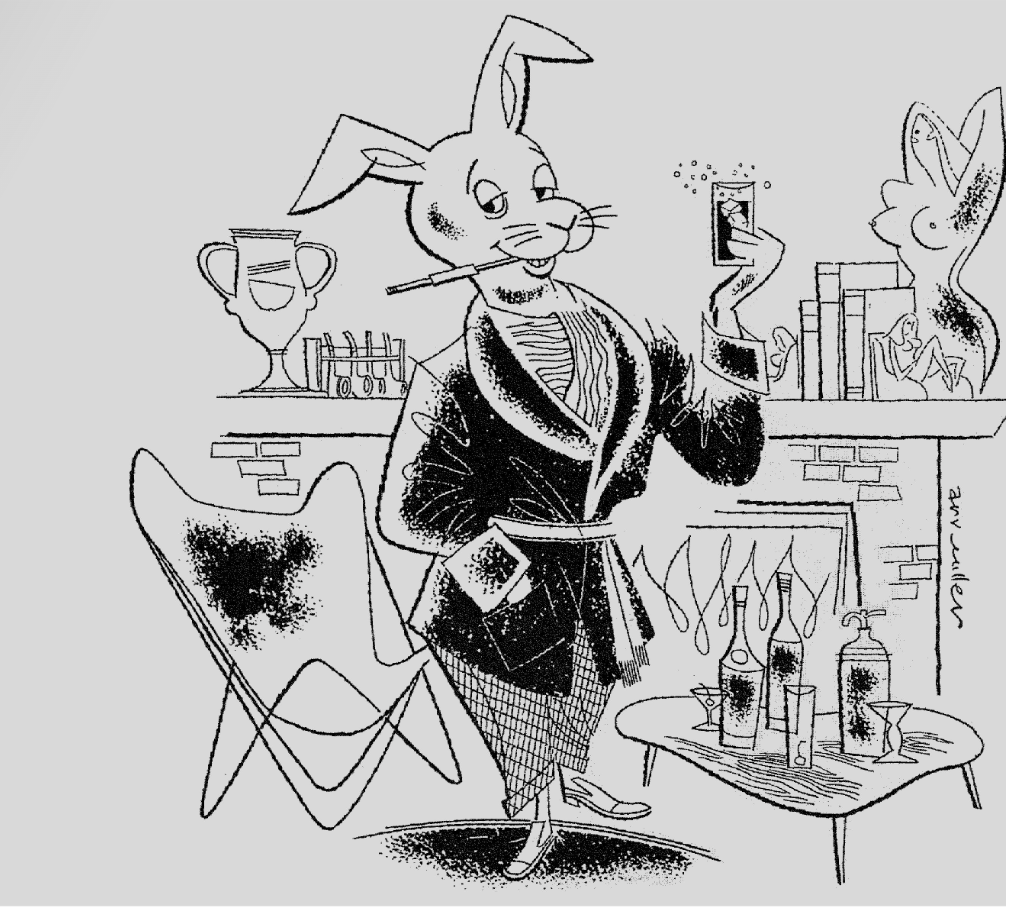
First and foremost the Playboy must be a man. If the gender bias wasn’t already painfully obvious by the use of the word “boy” in its branding, then Hugh Hefner’s insistence that ‘if you are somebody’s sister, wife or mother in law and you have picked us up by mistake, that you please pass us along to the man in your life and get back to your ladies home companion2 ‘ would definitely get the point across.
Like the famous not for girls marketing of the Yorkie brand in the early 00s, Playboy established itself as a just for men lifestyle magazine at a time where only two other publications existed in this category, priding itself on its styling of masculine taste.2
The articles of this first issue painfully reflect this with Bob Norman being given pages of space to express his frustration at paying alimony to his ex wife, comparing giving her money to buying oats for a dead horse3. The article ‘Miss Gold Digger 1953’, seems to encourage the lifestyle of a bachelor , painting wives as parasitic creatures that bleed men dry of money and with hold sex. In an attempt to ‘bolster the male ego by destroying woman’s’ 4. Playboy separates the women in its pages into two categories : sexual objects and women as they relate to the reader instead of people in their own right, at least to begin with.
The women in the pages are playful and sexually liberated, while any woman that exists outside its confines are boring, and uptight. Perhaps the decision to condemn marriage in this way was a reflection of Hefner’s growing distaste with his own relationship .
Hefner was not himself a Playboy when he launched the magazine, he was a poor college graduate married to a woman who had cheated on him, and the father to a 1 year old girl. Hefner’s interests in jazz, culture and women were indeed reflected in the first issue but the lifestyle he encourages of his readership was far from the lifestyle he was living. In this way Playboy not only represented a fantasy for its readers to strive towards5 but Hefner’s own alter ego, the man who could have it all – the man he would eventually become.
Published straight after Norman’s takedown of the institution of marriage, the article “Strip Quiz” depicts a naked woman playing a quiz game with two fully clothed men6.
Not only does this boost the male ego by implying that the women is losing a general knowledge game, it decides that within the covers of Playboy it is only women who are naked , not the men.
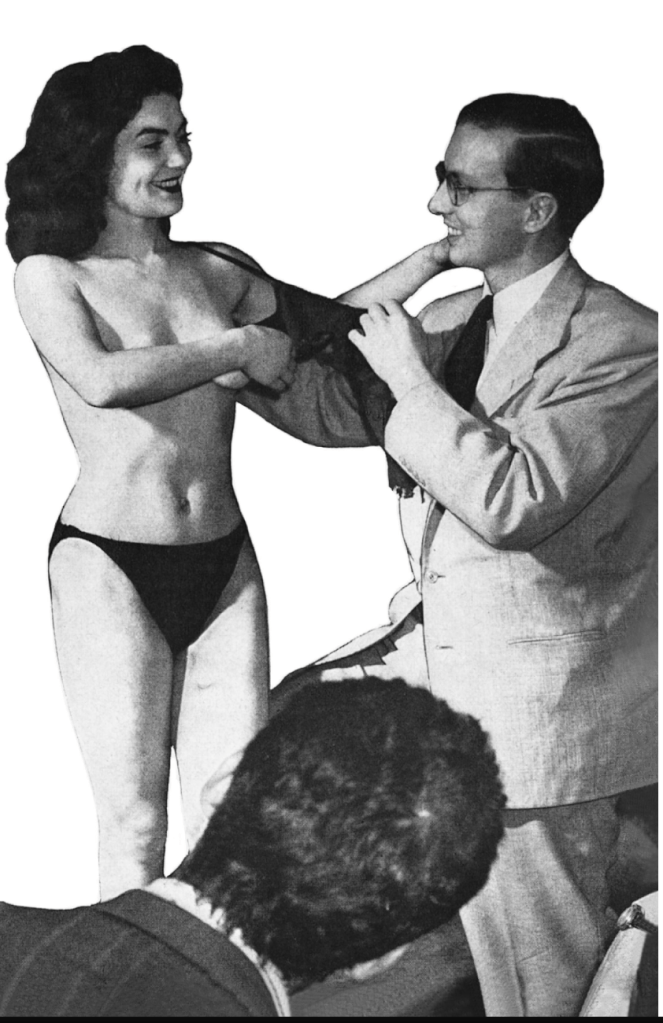
While Hefner does advocate for gay rights and will go on to publish articles in the subject later on in the publication’s history, the decision to only publish women naked assumes the heterosexuality of the reader, enforcing that the Playboy as a concept is a straight male.
It is also true that due to media laws in the 50s publishing men and women naked together , or photographs of a full frontal male model, would have proven difficult. However, the inclusion of men in the pictures with women draws attention to their nakedness and establishes them as playthings not only for the men in the photographs, but for the reader. Of course these women would eventually become ‘Playmates’ a nod to Hefners branding but also a label that places hierarchical value on the male viewer.
Before I get ahead of myself and deconstruct the idea of the Playmate (which hadn’t yet been established as a term in the Playboy lexicon ) let’s return to Strip Quiz and the identity of the Playboy.
We know little about the woman in Strip Quiz aside from the fact that she is clearly not very good at general knowledge. However in the brief accompanying text that goes along side the pictorial , this simple game wherein the loser loses and item of clothing, is described as “European” a word which at the time had connotations of sophistication and forward thinking6.
America is often seen as the prudish distant relative of Europe, with the idea that nakedness and sexual liberation is rife across the pond. Americans often look to European countries as a places of great cultural capital so to describe this sexual game as European, legitimises it and makes the enjoyment of a naked body seem like an intellectual pursuit.
Playboy is often concerned with the cultural capital of its contents and by extension assumes or encourages the reader to be the sort of man who concerns himself with intellectual stimuli. Hefner paints the picture of the Playboy as a worldly figure by asking the reader if he is the sort if man who would “invite a female acquaintance for a quiet discussion on Picasso, Neitzsche , jazz, sex 1 ‘.
The Playboy isn’t a lecherous acne riddled ,hormonal teenage boy, the Playboy is an intelligent and sophisticated man who enjoys sex and is invited to enjoy it without shame. Hugh makes sex seem smart, and makes smartness seem sexy. He makes porn acceptable to a 1950s audience by framing it as an academic pursuit, it’s between the pages of freshly translated Boccaccio! How can it be wrong?
Finally a man had an excuse to engage with pornography, he was purchasing it for the articles. The naked women just happened to be there, like shadows of people running to the bathroom at the cinema, it only got in the WAY of what you are really there to see .
Of course Hefner happened to be passionate about the articles he published and was a fan of most of the things he selected, but this clever marketing technique managed to bypass the prudish values of 1950’s America and indeed allowed men to consume pornography freely across the globe in years to come.
The marketability of playboy as a publication was immense, and it is no wonder that it went on to be one of the largest magazine publications of all time. Hefner even built consumption into the created identity of his readership prepping them for future advertisements.
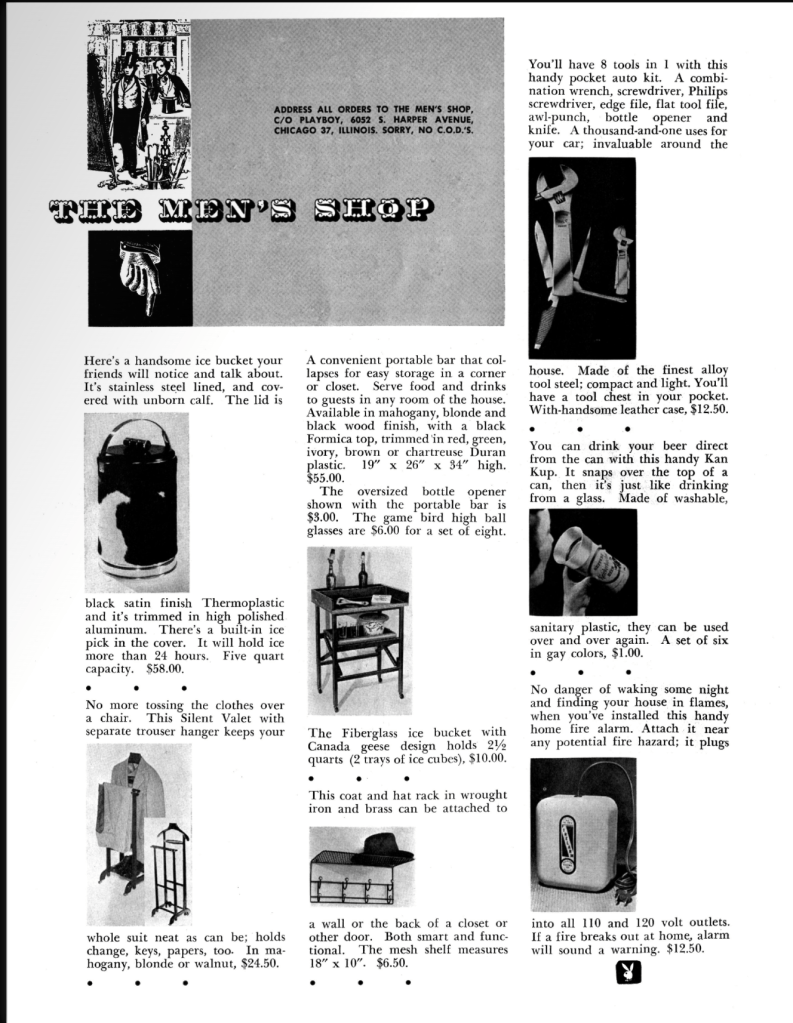
The Playboy is an identity that can be brought. Aside from the gender bias, the marks of a Playboy are all linked to consumption. You can become intelligent by consuming culture and according to Hefner , you can access beautiful women by enticing them with the lifestyle that you market to them with the goods you have purchased.
In a pictorial called ‘An Open Letter from California’7 the model is portrayed as the girl next door who is entranced by the authors pool , and therefore is willing to engage in sexual play with him. Hefner creates a life for the reader to aspire to, if you want sex, success and intelligence you must become a Playboy, and to become the Playboy you must consume.
Bibliography
- Bernays, Edward. Propaganda. Ig Publishing. 2004
- Hefner, Hugh. ‘Volume 1 , Issue 1 : Introduction’. Playboy, December 1953, p3, Iplayboy.com Accessed November 11th 2022.
- Norman, Bob. ‘Miss Gold Digger 1953’. Playboy, December 1953 , p6-9, Iplayboy.com Accessed November 11th 2022.
- Rossi, Lee D. ‘The Whore Vs the Girl Next Door : Stereotypes of Woman in Playboy, Penthouse and Oui’. Journal of Popular Culture, 1975, Volume IX (1), p 90-94.
- Gunelius, Susan. ‘The Brand Dream’. Building Brand Value the Playboy Way. Palgrave Macmillan 2009.
- ‘Strip Quiz ‘. Playboy, December 1953, p10-11, Iplayboy.com Accessed November 11th 2022.
- ‘An Open Letter from California’ . Playboy, December 1953, p27-29, Iplayboy.com Accessed November 11th 2022.
 The Playboy Project
Leave a comment